
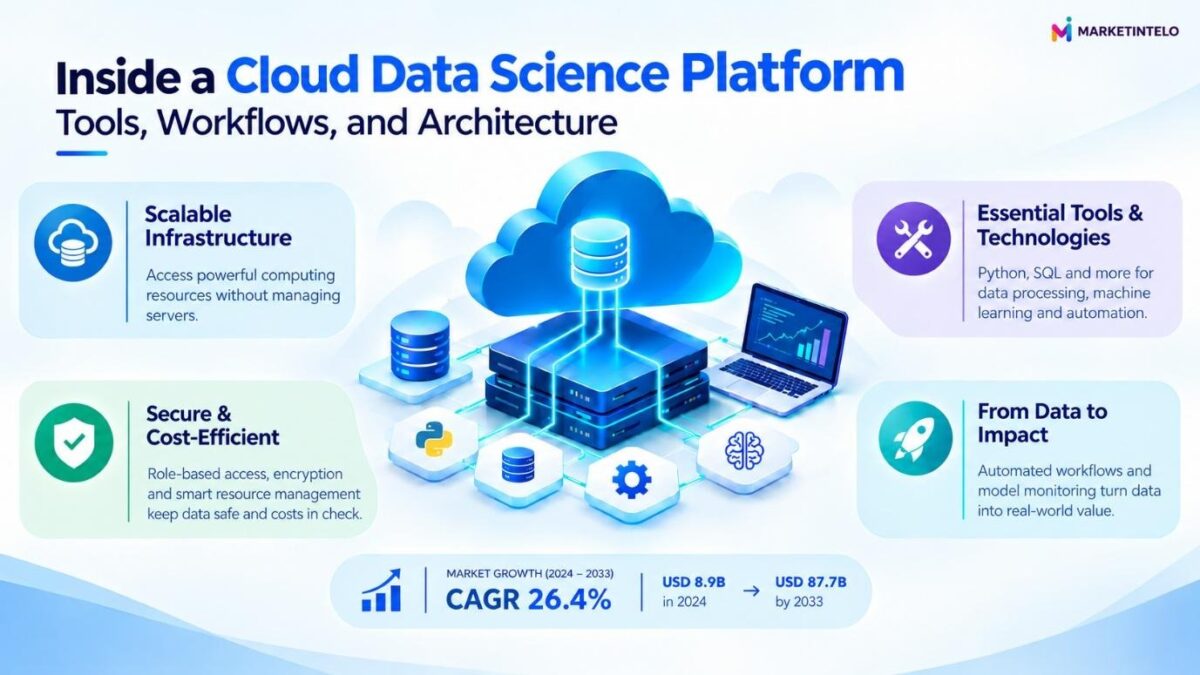
Inside a Cloud Data Science Platform: Tools, Workflows, and Architecture

Definition of Cloud Data Science Platforms
Cloud data science platforms are holistic systems for data storage, processing, programming, machine learning, and collaborative work. Organizations can utilize cloud technologies in order to utilize computing resources without the need to maintain their own servers.
In addition to this, the power of processing can be changed depending on the workload. Furthermore, it can be used for a number of projects ranging from analysis of millions of customer records to processing millions of events produced by connected devices.
Since data is constantly growing in volume, the importance of proper techniques for data collection, processing, and analyzing increases. A cloud data science platform is a means of bringing together data engineers, analysts, and data scientists, making their work less fragmented.
Cloud Data Science Platform Architecture
The architecture of most cloud data science setups can be described as a layered architecture involving the following four layers: data ingestion, storage, processing, model development and deployment. Each layer serves a different purpose needing to be used to exchange information. By separating the responsibilities, the team members can change only some components of the cloud architecture.
In the in-take section, different sources are used to gather data. For instance, data from databases, software programs, different sensors, and streams is gathered. After that the storage compartment takes responsibility for keeping both raw data and processed information while data processing is the name of this stage. Finally, the in-development compartment consists in using different notebooks to get the results of the tests carried out.
The ability to scale is an essential characteristic of this architecture. A system that processes 10 GB of information may utilize a simple setup, while a system that deals with 10 TB of information may need to harness the power of distributed processing. Considering that 10 TB is equal to 10,000 GB in the decimal system, it is clear that such a difference has a drastic impact on processing time, memory capacity, and financial expenses.
The popularity of cloud analytics is supported by market projections. As per Dataintelo, the worth of the worldwide Cloud Data Science Platform market was USD 8.9 billion in 2024 and it is likely to reach USD 87.7 billion with a CAGR of 26.4 percent by 2033. According to the trend, scalable computing, data management, and machine learning processes continue to gain significance in big data management and execution of complex analytics tasks.
Technologies and Instruments That Are Essential
In the general case, a platform combines various software categories rather than using a single software application. In addition to data preparation and machine learning, Python has a role to play in data processing. At the same time, SQL remains relevant in the process of obtaining structured data.
Distributed processing technologies manage tasks, which are impossible to carry out in single machines. Object storage systems are capable of operating with large datasets, whereas scheduling tools provide principles for synchronizing predefined activities. Version control helps to keep track of code changes, whereas experiment monitoring records parameters and different metrics.
| Tool category | Primary function | Practical example |
| Python and SQL | Analysis and transformation | Cleaning 5 million records |
| Object storage | Dataset retention | Storing 2 TB of images |
| Distributed computing | Parallel processing | Processing 10 TB of events |
| Notebooks | Exploration and testing | Comparing 4 algorithms |
| Model registry | Version management | Tracking 12 model releases |
| Orchestration | Workflow scheduling | Running 24 daily pipelines |
The usefulness of components can rise when there are permanent rules of allowing access, common metadata, and possible transfers. When there are no connections, teams may repeat the datasets, forget the details of certain trials, or be unable to re-create the findings after many days.
From Raw Data to Reliable Results
Cloud data science workflow generally goes through six major steps in its process: data collection, data verification, data preparation, data analysis, model training, and model evaluation. Automating these stages allows this process to be completed by a machine without the need for human intervention.
One important aspect of this process is data quality. For example, a data set containing 1 million transaction records with the missing data rate of about 3 percent across 30,000 records can lead to important problems in the future if things like missing values, duplicated records, or values being outside the expected range are not detected with the help of validation rules.
A practical workflow often includes these activities:
- Preparation: Creating a standard for formats, removing duplicates, and keeping a record of the data transformation;
- Experimentation: Training 3-5 candidate models on a consistent evaluation dataset;
- Validation: Measuring the performance by comparing precision, recall, and other important characteristics;
- Automation: Setting up daily/hourly pipelines as needed by the application;
- Monitoring: Keeping track of the prediction quality, processing errors, and incoming data changes.
Reproducibility depends on the tracking of the dataset version, code revision, software dependencies, and model parameters. In the case an experiment run with 20 parameters for 50 times, with the help of a systematic approach it is easy to understand what parameter configuration produces the best outcome.
Cloud Security and Cost Management
Cloud solutions come with shared-responsibility problems. While the provider takes care of the physical infrastructure, it is the customer’s task to implement access limitations, data management, etc. Role-based access limitations guarantee access to sensitive data only to a certain user group. Encryption provides secure data transmission and storage.
Cloud computing expenses are determined by the processing time, amount of storage used, amount of data transmitted, and expenses related to managed services. The computation of a cluster number of eight virtual machines worked for five hours will result in 40 vm hours. Efforts like reducing non-essential runs, turning down idle resources, and properly adjusting instance sizes will reduce costs without affecting analytical quality.
Deployment and Monitoring of models
A successful experiment is only the start of utilizing a data product. Model deployment can be defined as the packaging of a trained model into a service, batch process, or embedded device. Models making predictions 100 times per second have completely different infrastructure requirements compared to those doing 10,000 overnight predictions.
After deployment, it is necessary to keep track of how the model performs. The companies evaluate its performance parameters, prediction quality metrics, as well as the possible data drift. For instance, if the average response time amounts to 300 ms instead of 100 ms, it is reasonable to investigate the reason of the threefold increase in response time by using relevant metrics related to performance assessment.
As a result, a cloud platform for data science is more than just a collection of data analysis tools. It consists of a number of things such as data, tools, experiments, associates, legislation, and more.


