
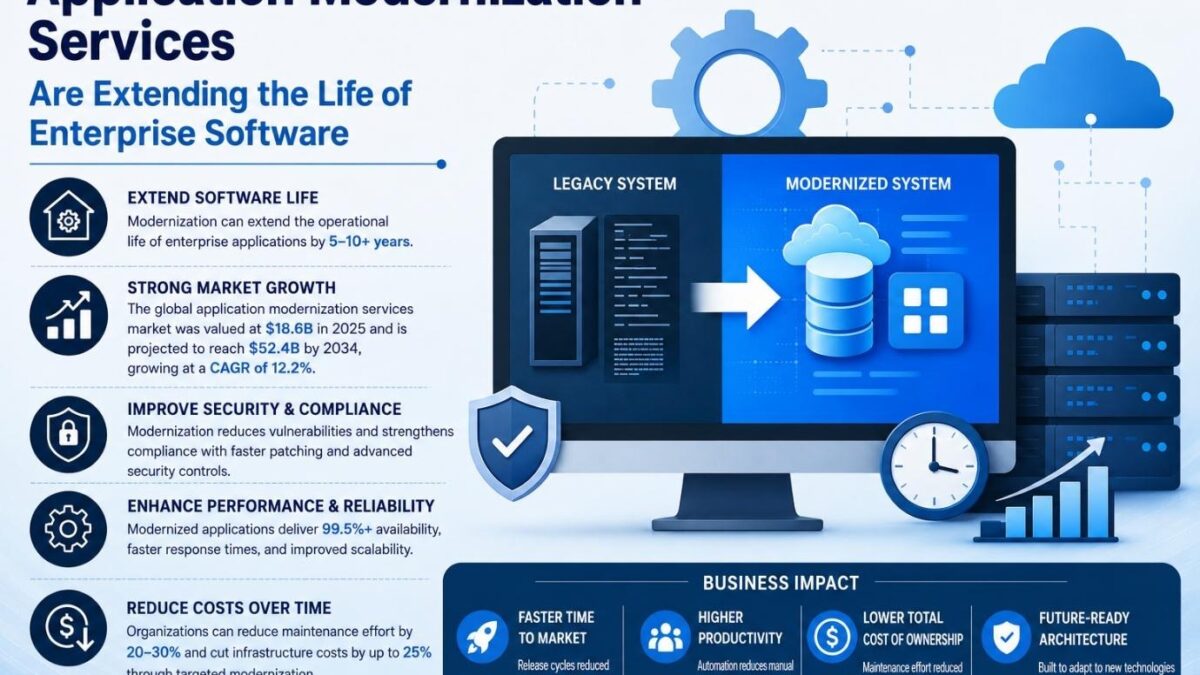
Application Modernization Services Are Extending the Life of Enterprise Software

Enterprise applications become obsolete only infrequently. Though old applications are still relevant, the underlying architecture, system infrastructure, and integration practices make them less manageable. Modernization of applications allows the continuation of the use of older systems by bringing them up to date without replacing them completely.
Modernization ensures, on the one hand, that the important and proven principles of operating business are preserved while, on the other hand, that the performance, safety, scalability, and compatibility of the systems are improved. If modernization of applications is organized properly and based on regular testing, thorough documentation, and phased implementation, the application can function for a decade and even longer.
The Importance of Legacy Applications
Legacy systems contain information about transaction logic, business logic, customers as well as experience on operation issues. Even systems that are quite old (15 or 20 years) can help resolve certain issues of business processes.
Updating legacy systems is connected to various risks of migration processes, including conversion of the data, changes related to integration, retraining of workers and downtimes. Modernization, on its part, presupposes keeping the positive aspects of modernization in some aspects and retaining the components that ensure its proper functioning.
The scale of this transformation is significant and easily provide measurable data. As reported by Data Intelo, the value of the global market of application modernization services was $18.6 billion in 2025, while by 2034, it will be worth $52.4 billion, showing the CAGR of 12.2% from 2026 to 2034. Such growth serves as proof of the important message on the need to prolong software life.
Read: Why Does Your Business Need a Website Redesign?
The Approaches to Modernization
The process of modernization could take many forms. Systems may need varying degrees of changes depending on the requirements.
Some of the methods include:
- Rehosting entails migrating an application with minimum adjustments to its code.
- Refactoring entails making modifications to an application’s code so that it becomes more maintainable while its main functions remain intact.
- Re-platforming refers to the shift of the application to a different environment in order to make it more effective without creating many disruptions.
- Rearchitecting entails changing the way the application is constructed, for example, from monolithic to modular architecture.
- Rebuilding refers to replacing significant parts of an application because its current platform fails to work efficiently.
A successful modernization project can involve the use of several methods at once. For example, a company may first rehost a 20-year-old application and then refactor it for a year and then architect it anew.
Cloud Acceptance and Longevity of Usage of Applications
Cloud environments facilitate modernisation with the help of elastic computing, managed databases and automated deployment processes. However, simply moving an unchanged legacy application to the cloud does not make it modern.
One way of doing it is creating the roadmap which identifies 5–10 main components of the application that will be assessed separately. Stateless services can be migrated first, while tightly coupled ones will stay on existing infrastructure until the dependencies stop being a burden.
Containerisation can help with portability. Automated deployment can shorten release times from weeks to days depending on the complexity of the project.
Improvements in Security and Compliance
The aging software modernization process is largely driven by the need for security. Most legacy apps are often based on deprecated software, and out-of-date libraries and weak security mechanisms, as well as their maintenance via manual patch management.
Modernizing legacy apps allows for the option of implementing MFA, encryption of data streams, and vulnerability scanning, as well as the possibility of consistent logging and monitoring of access.
With a reduction in the patching cycle from 30 to 7 days, the time frame within which threats have exposure becomes much shorter and more robust security mechanisms are built into the lifecycle of the application.
Cost Management by Selective Reengineering
Modernization does not lead to lower costs during transition. Some projects may necessitate operation in two environments, migration effort, testing, training, and integration work.
Cost optimization is the goal of such initiatives. If an application has to be maintained 40 hours each month because of unoptimized code, targeted refactoring may allow for simpler maintenance in the future. Automated testing can help decrease the volume of work by eliminating repetitive tests for hundreds of release scenarios.
To carry out such evaluation, it is essential to assess four important factors: cost of infrastructure, maintenance time, incidents incurred, and time taken to roll out changes. Tracking these measures will provide clearer picture of how effective modifications are implemented.
Measuring the Impact
Outcomes from modernization can be easily assessed if the technical modifications are linked to specific quantifiable indicators of success.
| Metric | Legacy Baseline | Modernization Goal |
| Release Cycle | 30 days | 7–14 days |
| Deployment Effort | 20 hours | 5–10 hours |
| System Availability | 98.50% | 99.5%+ |
| Recovery Time | 8 hours | 2–4 hours |
| Manual Testing | 60% | Below 30% |
While actual results of modernization can depend on factors such as architecture, workload, and governance, specific targets will assist in distinguishing modernization from simple movement of infrastructure.
Issues That Need Strategic Planning
Technical interdependencies can be a major cause of problems in modernization projects. Applications can be dependent on many databases, APIs, batch processes, and reporting applications. Changes made to just one single interface may trigger many consequences downstream.
Conducting tests is of prime importance. Large enterprise applications can be subject to hundreds of test cases for different types of testing such as functional tests, security tests, load tests, etc. The third key factor is continuity of data, as missing or duplicated records can lead to serious problems.
Employing a phased approach may reduce risks of failure. Dividing a project into several releases (for instance, into 4 releases) enables to test architecture, data and performance before continuing to broader rollout.
Keeping Software Alive by Means of Modernization
Modernization in software applications is more about controlled evolution rather than wholesale replacement nowadays. The relevant logic of business processes can be maintained while old-fashioned infrastructure, code, interfaces, or methods of protection are being modernized.
Modernization allows creating a software environment ensuring new integrations, immediate releases, increased security, and changing requirements for up to 5-10 years. Application modernization services thus promote the achievements of companies.


