
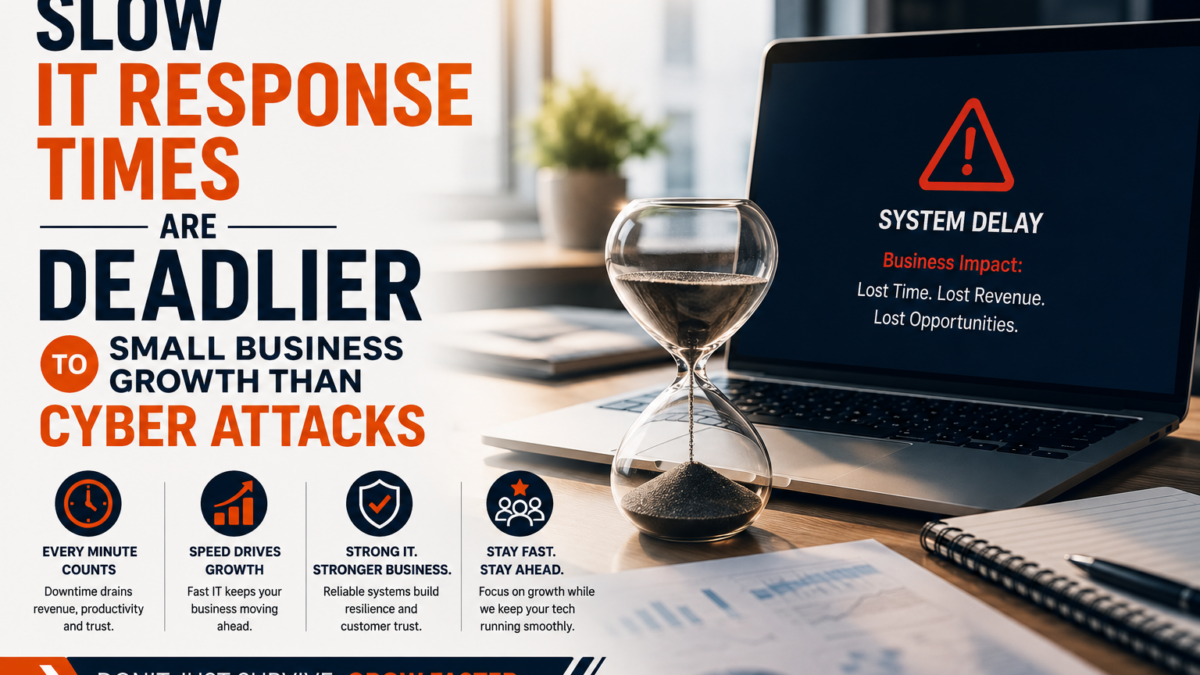
Why Slow IT Response Times Are Deadlier to Small Business Growth Than Cyber Attacks

Imagine you are running an e-commerce company that is gradually booming. Suddenly, your router connection stops working, and lacking adequate IT support lets your business suffer for many hours a day. The entire IT infrastructure pauses. What if this condition persists for three more days? In those three days, your e-commerce products remain unshipped, and you even lose all your money for the same week.
In the world of business, information technology is a major game changer. It encompasses the electricity, Wi-Fi, software, and computers that keep your business up and running. Though the cases of a digital version of a bandit trying to steal your sensitive records are high, the foremost thing ruining your business is slowing IT response time.
Read: WordPress vs. Custom eCommerce: The Ultimate Showdown for Online Stores
The Hidden Cost of “Just a Minute”
Cyberattacks are often considered the topmost threat that online businesses face; they are like a storm knocking down a fence. However, slow IT issues are like slow poison, gradually making the system die or halt.
When a small business has a technical problem—perhaps the POS is freezing, or the cloud server is lagging—employees cannot work smoothly. The employer must pay for hours that they spend sitting idle, staring at loading screens and waiting for the system to catch up.
Consider these realities:
- The Price of Waiting: Research clearly states that for many modern businesses, even just one hour of major technical breakdown or downtime can make your whole business empire succumb to technical errors. It can cost up to $300,000 due to lost productivity and missed sales opportunities.
- The Survival Gap: A staggering 75% of small businesses suffering a major technical disruption without any backup or a fast recovery plan shut down within three years. They fail to afford the cost of being “off the grid”.
- Customer Loyalty: In this fast-paced world, customers are impulsive and have no patience. If your website is offline or your product page loads slowly, they immediately look for alternatives without waiting for you to fix it. A broken link even leads to a high bounce rate, which is your competitor’s gain. Consequently, customers often equate poor website speed with bad business availability.
Why “Slow” Beats “Cyber Attack”
It is certainly counterintuitive to say that slow service is worse than a cyberattack, as a cyberattack is a malicious attempt. However, both conditions differ. A cyberattack is usually a single event that can be fixed, and you move on, having learned from it.
On the flip side, slow IT responses resonate with chronic conditions. If your employees pause 20 times a day for a document to open, or if your system restarts two or three times taking 2–3 minutes every single afternoon, it costs you significantly every single day of the year. Over a year, those 10- or 20-minute delays sum up to hundreds of hours of payable time.
Unlike large enterprises, small businesses often operate on very thin margins, meaning they do not have extra money to waste. For big companies, it is manageable to adjust the loss of one department with the profit of another. But for a lean business, that same week could mean not being able to pay the rent. Overall, slow IT is a slow-motion car crash; it continues to drain life out of a company before the owner even realizes that something is not working correctly.
The Hero in the Pit Crew: Dedicated IT Teams
So, what is the cheat code for a business to stay fast? Smart businesses do not just “wait for a digital disconnect.” Instead, they treat their IT like a professional “Formula 1” team.
Just as in a car race, the pit crew does not wait for the car to break down. Rather, it starts repairing proactively, watching tire pressure, engine temperature, and every bolt while the car is moving. This symbolizes the role of a dedicated IT team for business.
A business cannot afford to wait 24 hours for a critical server patch, making it vital to focus on navigating technical glitches with dedicated IT teams that offer guaranteed Service Level Agreements (SLAs), which emphasize:
- Proactive Health Checks: As the health of an IT infrastructure is non-negotiable, a dedicated team does not wait for a system crash to occur. It proactively monitors all IT systems to ensure that the heart of the business is beating. Whatever errors they notice, they fix them at the very moment, without you even noticing.
- Instant Reaction: When a real problem occurs, a dedicated team comes upfront to support without involving a third-party help desk, which keeps you waiting for hours. It acts as an extension of your business because it knows everything from your highly confidential passwords to your prospective goals. It is like lightning for your company.
- Freedom for Owners: Every digital business requires IT experts. They should not manage technical glitches with part-time technicians. When IT experts handle these issues, business owners and top leaders can focus on evolving new products, delivering better customer experience, and scaling the company.
Conclusion
The most successful companies in the present scenario are the ones that have mastered the speed of delivery and production. Just having a good product is not enough; you must have a seamless, fast, and reliable digital engine to streamline and push your workflows.
A business cannot afford to wait 24 hours for a critical server patch, making it vital to focus on accelerating technical issue resolution with dedicated IT teams that offer guaranteed Service Level Agreements. If you are a small business owner, avoid looking at your IT support as an “expense”; count it as an investment in your speedy workflows. The businesses investing in dedicated IT teams are essentially buying back their own precious hours. This decision helps them attract opportunities by leveraging fast systems. In the end, growth is all about momentum. Every second your IT infrastructure halts; you lose speed, which is essential for fast growth and scalability.


